

UZBEKISTAN corporate bonds: TRADE IDEA RECAP
12 months ago (at WSI 2025)
+35.77% in USD terms
USZ coupon of 29% and currency gain of 5.25%
+35.77% in USD terms
USZ coupon of 29% and currency gain of 5.25%
On top of this:
- Re-invested monthly coupon to new issues for further compounding
- Current yields to maturity (new issues coupons) for the same issuers have compressed to 24-25% in USZ
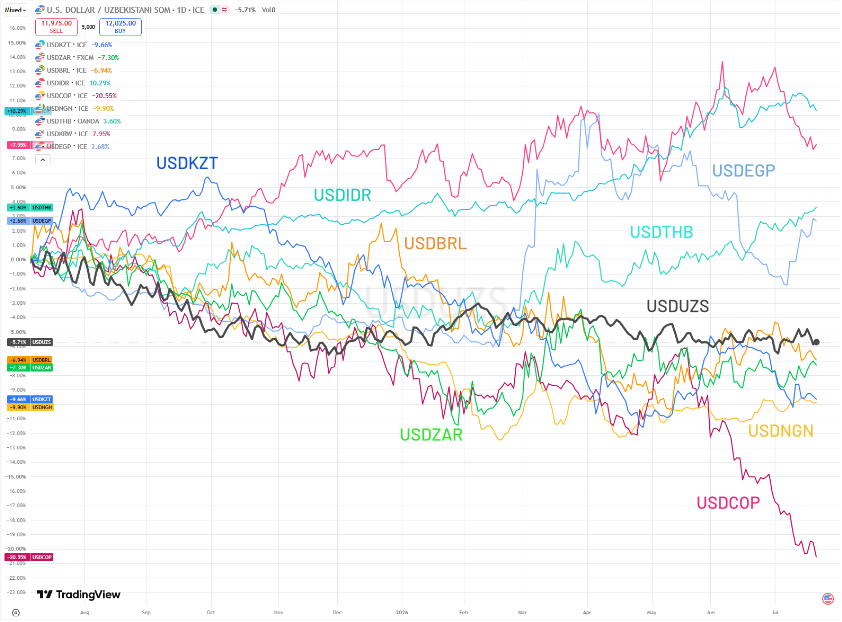
Most commodity-linked currencies appreciated against USD during past 12 months. I am bearish EMs with little natural resources and low human capital (median IQ as proxy), in the age of robotics and AI.
UZBEKISTAN: INTRO & MACRO
Uzbekistan Population: 39 million
GDP in 2025: $147.0 bln
GDP per capita 2025: $3850
GDP per capita 2025 based on PPP: $14,000 (e.g. Egypt, South Africa)
Real GDP growth 2025, 7.7%, 1Q 2026 - 8.3%
GDP breakdown by sectors:
Foreign reserves, as of June 2026, $65.75 bln
Gold in foreign reserves: 85.0% - very high (Poland is 2nd at 30%)
Base Rate (Central Bank of Uzbekistan): 14%
Inflation, CPI: 6.4% (as of June 2026)
Real rate: 7.6%
Reserve rates: LC (UZS) 4%, FC (USD, EUR, CNY) 14.0%
Gold accounts for 30% of total exports, services over 20% in exports.
Total exports, 2025, US$: 33.8 bln (+21% vs 2024)
Total imports, 2025, US$: 47.3 bln (+18.5% vs 2024)
Uzbekistan is ‘very long gold’ - which can be a positive or negative.
GDP in 2025: $147.0 bln
GDP per capita 2025: $3850
GDP per capita 2025 based on PPP: $14,000 (e.g. Egypt, South Africa)
Real GDP growth 2025, 7.7%, 1Q 2026 - 8.3%
GDP breakdown by sectors:
- Services (includes trade & financials): 44%
- Industry (Mining, Processing): 23.5%
- Agriculture: 20.6%
- Construction: 7.1%
Foreign reserves, as of June 2026, $65.75 bln
Gold in foreign reserves: 85.0% - very high (Poland is 2nd at 30%)
Base Rate (Central Bank of Uzbekistan): 14%
Inflation, CPI: 6.4% (as of June 2026)
Real rate: 7.6%
Reserve rates: LC (UZS) 4%, FC (USD, EUR, CNY) 14.0%
Gold accounts for 30% of total exports, services over 20% in exports.
Total exports, 2025, US$: 33.8 bln (+21% vs 2024)
Total imports, 2025, US$: 47.3 bln (+18.5% vs 2024)
Uzbekistan is ‘very long gold’ - which can be a positive or negative.
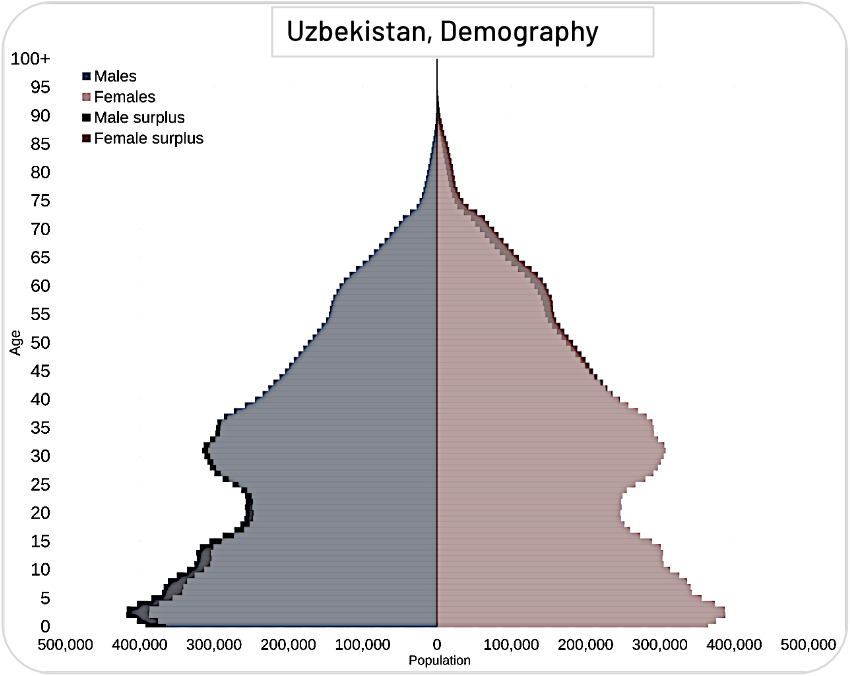
Healthy demographic structure in contrast to many other parts of the world - solid basis for current and prospective economic growth
Fertility rate: 3.4, Median age: 27 years
Median IQ: 87-89 (Lynn & Becker 2019)
Data Sources: Central Bank of Uzbekistan, National Statistics Committee of Uzbekistan, World Bank, Atlas of Economic Complexity - Harvard University; *World Economics estimate
LOCAL BANKING SECTOR: CONTINUING GROWTH
FX regime liberalization of 2017 together with financial sector reforms enabled inflow of foreign capital into Uzbekistan, especially financial sector.
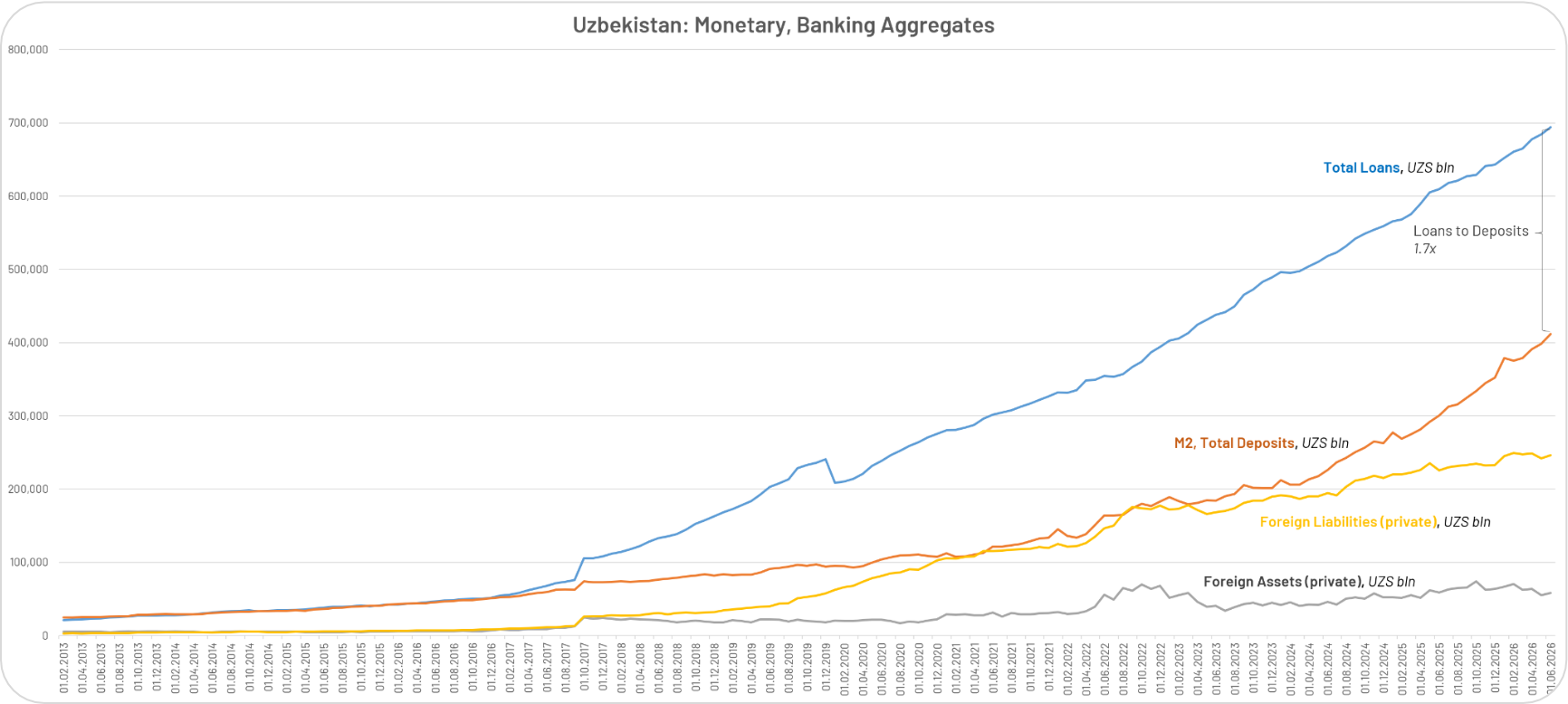
Average total loans growth in the country during past 5 years exceeds 14.5% p.a. (in local currency terms)
Loans to Deposits ratio has improved during past 12 months from around 200% to 170% (but still high) - mostly due to local deposits creation.
As a result, now total foreign debt is near 58% of GDP, while government debt to GDP is near 28%, and foreign liabilities are 4.2x time of foreign assets (excl. CBU reserves).
Approximately 65% of loans extended by commercial banks are in foreign currency, which remains a legacy of the pre-2017 pegged and controlled FX regime.
NPLs level at commercial banks slightly decreased in June 2026 vs June 2025 from 4.2% to 3.7%.
Though by our estimates, NPL levels at banking system could be significantly understated, especially at state owned banks. For instance, by our estimates for certain state-owned banks estimated levels of NPLs EoY 2025 reported vs estimated:
NPLs level at commercial banks slightly decreased in June 2026 vs June 2025 from 4.2% to 3.7%.
Though by our estimates, NPL levels at banking system could be significantly understated, especially at state owned banks. For instance, by our estimates for certain state-owned banks estimated levels of NPLs EoY 2025 reported vs estimated:
Our estimate of real NPLs is based on calculating the difference between accrued and cash interest income on loans portfolios, as well as on study of loan stages and whether provisions are matching
In recent years, lending to individuals and self employed persons was the main driver of loan growth - around 2x the corporate lending growth rate.
Though most outstanding loans are still to companies, with individuals and self employed persons making up 37% of loan book.
In recent years, lending to individuals and self employed persons was the main driver of loan growth - around 2x the corporate lending growth rate.
Though most outstanding loans are still to companies, with individuals and self employed persons making up 37% of loan book.
TOTAL LOANS OUTPACING M2 DEPOSITS BY NEARLY 170% (IMPROVED VS 2025 BUT STILL VERY HIGH)
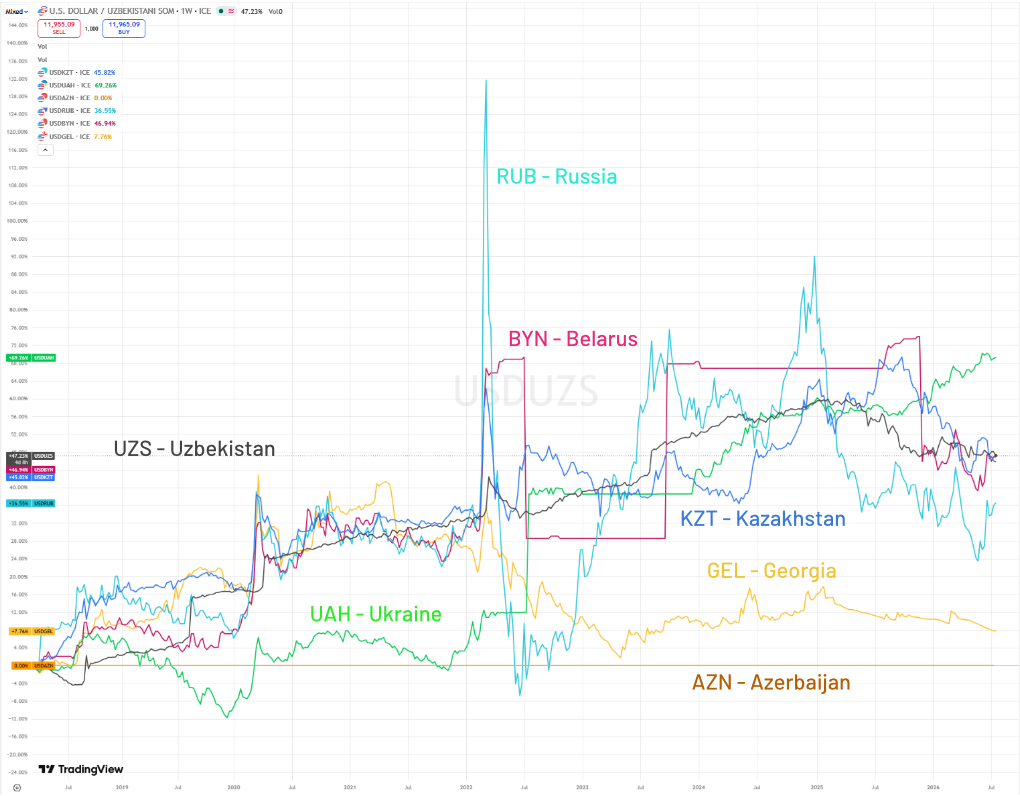
UZS WAS AMONGST THE WORST PERFORMERS PRE-2017 — BUT HAS IMPROVED SINCE
UZS (Uzbek Som) used to be among worst performing former soviet bloc currencies.
Since FX regime change and liberalization in 2017 it performs nearly at par with regional and FSU peers
Since FX regime change and liberalization in 2017 it performs nearly at par with regional and FSU peers
Total USD appreciation vs UZS during last 5 years (Mid’2021-Mid’2025) was 13.0%, or near 2.5% per year
While Uzbekistan Central Bank base rate during this period was in range of as high as 17% and as low as 13.5%, and the difference with Fed Funds Rate was ranging from 13.9 percentage points in 2021 to 16.8 pps in early 2022 and declined to 10.5 pps as of July’2026
Post-2017 selected FSU currencies performance
Data Source: Tradingview
UZNIF SHARES AS UZBEKISTAN ETF PROXY
While local stock market is quite thin in terms of active names and liquidity Uzbekistan National Investment Fund comprising 13 large state-owned companies had successful IPO on LSE in June of 2026
Oversubscription reached nearly 5x times
Institutional names, asset managers participated - 160
Fund Manager - Franklin Templeton
Oversubscription reached nearly 5x times
Institutional names, asset managers participated - 160
Fund Manager - Franklin Templeton
Among the top-3 largest constituents in NAV terms:
Uzbekistan Airways - 16.5% of NAV
Uzbek Hydroenergo - 16.0%
Uzbektelecom - 15.2%
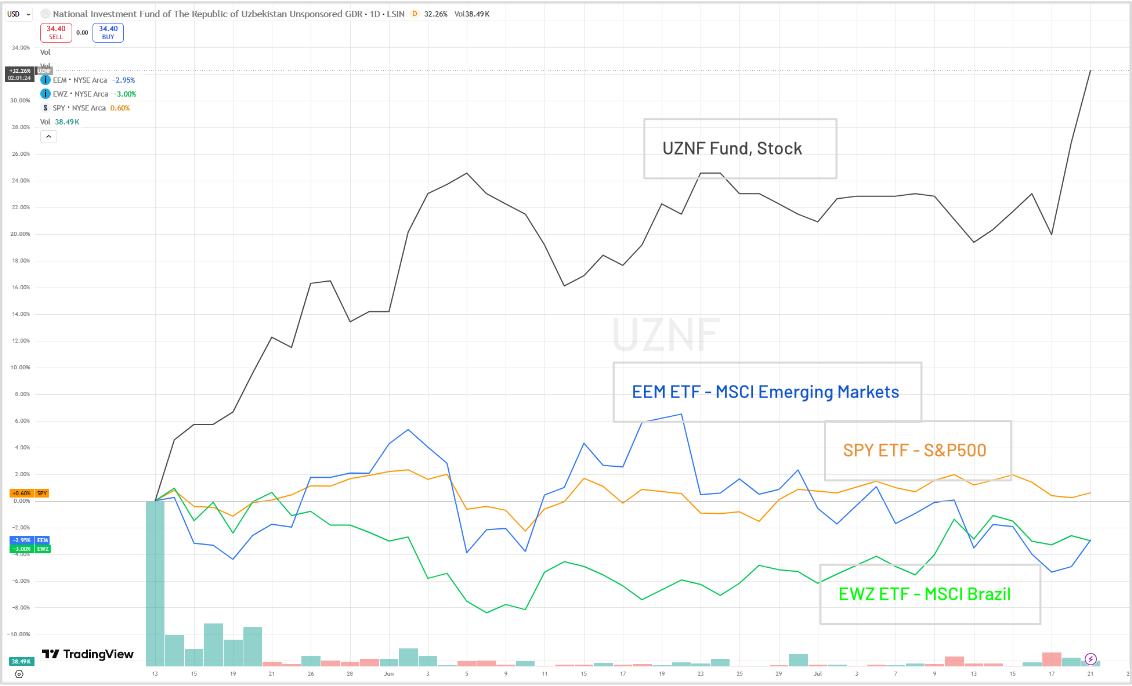
After recent IPO UZNIF outperforms selected EM and DM ETFs
Data Source: Tradingview
OVERVIEW OF UZBEK FIXED INCOME OPTIONS: GOVERNMENT BONDS AND BANK DEPOSITS
Main UZS fixed income broadly available for investors: local government bonds, local corporate bonds and bank deposits.
1. Local Ministry of Finance government bonds
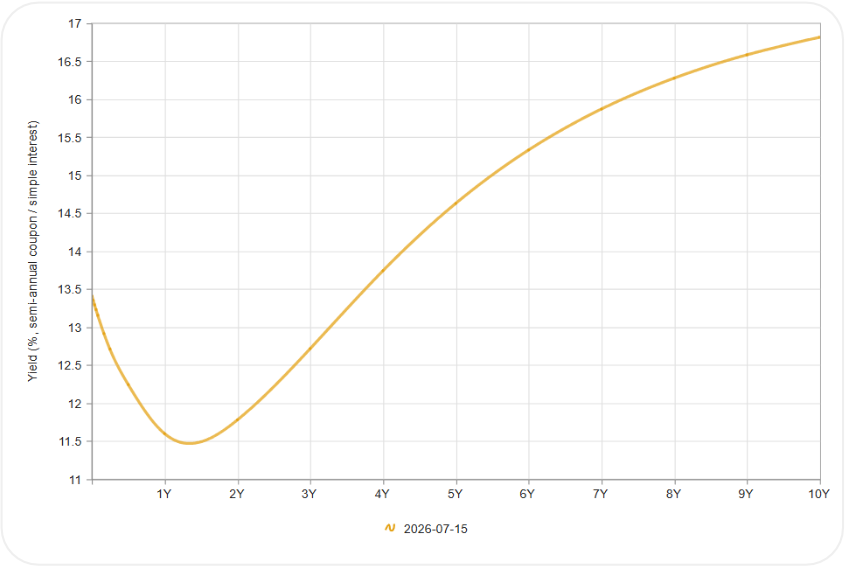
On average issued nearly 500B of UZS debt per week this year, approx. $41 mln equivalent. With YTM for 1-3 year maturities mostly in range of 12.0% to 12.6% (see chart)
Secondary market activity is near 20% of primary market (mostly buy and hold investors).
On average issued nearly 500B of UZS debt per week this year, approx. $41 mln equivalent. With YTM for 1-3 year maturities mostly in range of 12.0% to 12.6% (see chart)
Secondary market activity is near 20% of primary market (mostly buy and hold investors).
2. UZS bank deposits
Currently average banks’ UZS deposit interest rates for 12+ months deposits range is 14-23%
Deposits are insured for all private individuals (including non-residents) for 200 mln UZS, approx. $15,500 equivalent
Currently average banks’ UZS deposit interest rates for 12+ months deposits range is 14-23%
Deposits are insured for all private individuals (including non-residents) for 200 mln UZS, approx. $15,500 equivalent
Current Government issues UZS Yield curve
Short-end up to 3-4 years is more relevant as in many other EMs, with longer term maturities being mostly theoretical and non tradeable
Short-end up to 3-4 years is more relevant as in many other EMs, with longer term maturities being mostly theoretical and non tradeable
Data Source: Central Bank of Uzbekistan, Uzbekistan Exchange
OVERVIEW OF UZBEK FIXED INCOME OPTIONS: LOCAL CORPORATE BONDS IN UZBEK SOM
3. Local corporate bonds in Uzbek Som
Currently 35 corporate bonds issues are available at Tashkent Stock Exchange, most of the volumes though are being traded either directly via brokers, HTM investments or traded on exchange via direct trades (Nego Board), i.e. OTC trades but settled via exchange.
Typical issue size is in the range of 5 to 50 bln UZS, with median around UZS 25 bln, which is equivalent to $0.4 mln to $3.9 mln, and median near $2.0 mln respectively.
Since 2022 till end of 2028 interest income on corporate bonds is exempted from income tax both for individuals and legal entities, including non-residents
Coupons of the current issues are ranging from 18% to 27%, with recent issues of late 2024 and early 2025 mostly in 23-27% range
Average maturity at issuance is three years for corporate bonds
Typical coupon frequency for corporate bonds – monthly
Investor profile: HNWI and affluent local investors, HNWI non-resident investors, foreign institutional local currency investors for HTM portfolios.
Total amount of corporate bonds traded on Tashkent Stock exchange in Q1 2026 amounted to $150 mln equivalent (UZS 1.8 trln) - due to two large placements – Asakabank and Mortgage Refinancing Company, which is 10x times comparing to Q1 2025.
Currently 35 corporate bonds issues are available at Tashkent Stock Exchange, most of the volumes though are being traded either directly via brokers, HTM investments or traded on exchange via direct trades (Nego Board), i.e. OTC trades but settled via exchange.
Typical issue size is in the range of 5 to 50 bln UZS, with median around UZS 25 bln, which is equivalent to $0.4 mln to $3.9 mln, and median near $2.0 mln respectively.
Since 2022 till end of 2028 interest income on corporate bonds is exempted from income tax both for individuals and legal entities, including non-residents
Coupons of the current issues are ranging from 18% to 27%, with recent issues of late 2024 and early 2025 mostly in 23-27% range
Average maturity at issuance is three years for corporate bonds
Typical coupon frequency for corporate bonds – monthly
Investor profile: HNWI and affluent local investors, HNWI non-resident investors, foreign institutional local currency investors for HTM portfolios.
Total amount of corporate bonds traded on Tashkent Stock exchange in Q1 2026 amounted to $150 mln equivalent (UZS 1.8 trln) - due to two large placements – Asakabank and Mortgage Refinancing Company, which is 10x times comparing to Q1 2025.
WHY WE FAVOR CORPORATE MICROFINANCE COMPANIES BONDS over other local currency fixed income instruments
- Better yield/quality/credit spread comparing to commercial banks;
- Monthly coupon frequency allowing to decrease credit and FX risk via collecting and converting coupon;
- Low exposure of issuers to FX risk, more transparent business model, no subsidized loans;
Data Source: Uzbekistan Exchange
CASE STUDY 1: LOCAL UZS CORPORATE BONDS ISSUER
Microfinance Company A
Sector: Microfinance Company, started in 2017, operates 46 branches (outlets) in 14 regions in Uzbekistan, serving over 50,000 clients.
Microfinance Company A - FINANCIALS
Data for Q1 and Q2 of 2026
- Total loans extended (net of provisions) – UZS 281.0 bln, approx. $23.4 mln equivalent, +28.5% since the beginning of 2026
- All loans are in local currency
- Loans are 100% collateralized, of which 56% with gold and precious metals, 28% with cars, 14% with real estate
- Loans up to 12m – 56% of portfolio, remaining 1-2 year loans
- Gross NPLs reported – 0.5% of the portfolio
- Own equity – UZS 131 bln
- Own Equity to total assets – 42.3%
- Net Profit 6M 2026 – UZS 36.0 bln
- ROE 6M 2026 annualized – 72.0%
Company demonstrates consistent results, no significant unusual or non-recurring items
CASE STUDY 2: LOCAL UZS & USD CORPORATE BONDS ISSUER
Microfinance Company B
Sector: Microfinance Company, started in 2018, operates 45 branches (outlets) in 12 regions in Uzbekistan.
Microfinance Company B - FINANCIALS
Data for Q1 2026
- Total loans extended (net of provisions) – UZS 186.0 bln, approx. $15.5 mln equivalent, +31.7% since the beginning of 2026
- Loans are 60% collateralized, 45% of gross loans are secured with cars, 8.5% with real estate. Improved from Q1 2024, when only 37.5% was collateralized.
- Loans up to 12 months duration – 63.5% of portfolio
- Gross NPLs reported – 2.8% of the portfolio
- Own equity – UZS 75.0 bln
- Own Equity to total assets – 26.7%
- Net Profit Q1 2026 – UZS 1.4 bln
- ROE 1Q 2026 annualized – 7.4%
Despite high growth the company demonstrates volatile results and comparatively low profitability
Data Source: Company financial reports, Uzbekistan Exchange, Central Bank of Uzbekistan
UZS DEPRECIATED AGAINST USD BY ~2.5% per year 2021
Illustration of return scenarios
To illustrate return sensitivity depending on various UZS depreciation scenarios expressed as a rise in USDUZS exchange rate.
For the illustration purposes and to clean from other factors, we have assumed that USD reinvestment rate for the whole (1, 2, 3 years) period at 0%. USZ coupon assumed at 27%.
We have also assumed that the investor converts UZS coupon into USD each month, thus limiting his/her exposure to UZS as well as to issuer’s credit risk. We also assume devaluation is evenly spread during the calendar year.
Result are presented as cumulative return for respective period (1, 2, 3 years) to illustrate for the effect of devaluation with mentioned inputs.
For the illustration purposes and to clean from other factors, we have assumed that USD reinvestment rate for the whole (1, 2, 3 years) period at 0%. USZ coupon assumed at 27%.
We have also assumed that the investor converts UZS coupon into USD each month, thus limiting his/her exposure to UZS as well as to issuer’s credit risk. We also assume devaluation is evenly spread during the calendar year.
Result are presented as cumulative return for respective period (1, 2, 3 years) to illustrate for the effect of devaluation with mentioned inputs.
High real rates and high coupon reduces currency risk
Calculations show that even with an extremely high UZS depreciation, investors may still expect positive USD return, assuming coupons conversion into USD.
Extreme case: 20% USD appreciation means 42% loss of USD value of capital during three years - but even that is compensated and results in USD positive returns due to very high UZS coupon and real yield.
UZBEKISTAN: KEY RISKS & RISK MITIGATION FACTORS
KEY RISKS AND FACTORS TO WATCH (most to less likely)
- UZS depreciation due to external, internal factors; Reversal of FX liberalization regime
- Economy slowing down, real wages decline, significant growth on NPLs;
- Competition may push lenders into riskier loans underwriting harming their profitability, bearing potential growing loan losses;
- Institutional deterioration if happens may potentially result in lower law enforceability leading to uncontrolled and unchecked defaults;
MITIGATING FACTORS
- Can convert monthly coupon into USD; Borrowers and Lenders (issuers) are not directly exposed to FX risks borrowing in local currency;
- People already borrowing at 30-40%+ interest rates, i.e. managing these kind of expenses, loan portfolios have high turnover, fast repayment; loan portfolios are mostly collateralized by hard assets;
- Limited holding period (1-2-3 years) may limit risk; also monitoring overall and individual financials; lending companies have high equity cushion, i.e. able to absorb losses;
- Currently a low probability risk. It will be complete reversal of the current policy and trajectory. This risk may be more material if local borrowings grow too much too fast, such as with competition between banks lowering lending standards.