
KAZAKHSTAN: INTRO, MACRO
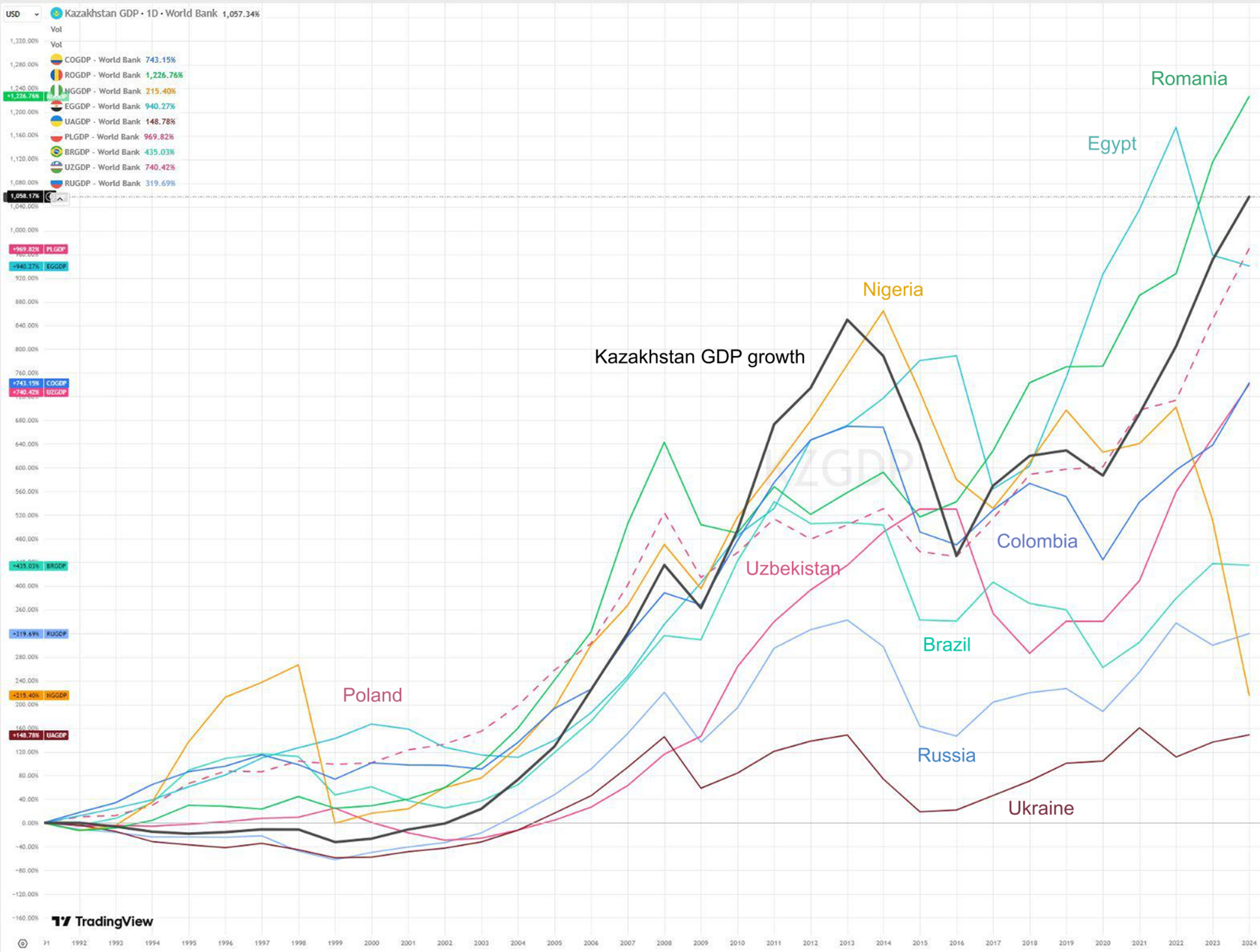
Kazakhstan GDP reached $ 344bln in 2025 (+6.5% in 2025) and GDP per capita reached over $ 15,000. 11.5x growth since independence in 1991.
For comparison world GDP per capita is near $ 13.5k, Argentina GDP/cap $ 14.4k, Brazil $ 12.3k, Colombia $ 8k, Egypt $ 4k
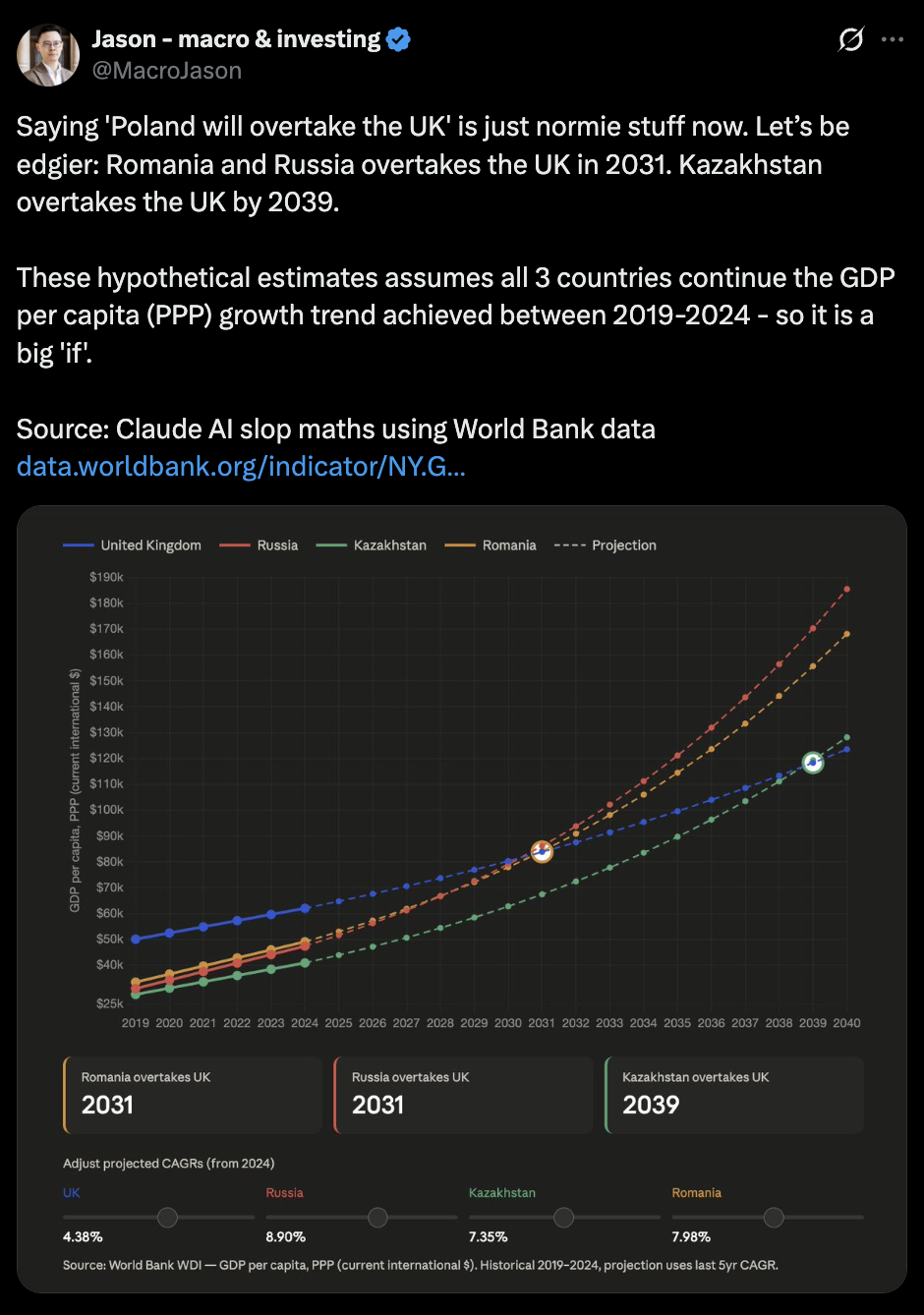
In GDP per capita (PPP) terms, Kazakhstan is wealthier than 4 EU countries and will overtake the UK within 15 years based on current growth rates.
Average GDP growth rate past 5 years (2021−2025) — 4.8%
Largest sectors by share in GDP: mining — 12.9%, manufacturing — 12.1%
Kazakhstan population — 20.5mln
Median age — 29.7 years
TFR: 2.95 (2025)
TFR: 2.95 (2025)
Kazakhstan foreign reserves including National Fund — $ 132.6bln
Gold accounts about 80−85% in National Bank’s reserves — $ 52.7bln equivalent (as of April 2026)
Debt/GDP — 24.6%
Current Account deficit in 2025 — $ 12.45bln (2.5% of GDP)
Main reasons of Kazakhstan’s CA deficit is growing import (+60% since 2021) while export grew +17.5% during the same period, and high primary income payments (share of foreign companies in resource sector, primarily oil and gas)
Main reasons of Kazakhstan’s CA deficit is growing import (+60% since 2021) while export grew +17.5% during the same period, and high primary income payments (share of foreign companies in resource sector, primarily oil and gas)
KAZAKHSTAN: HIGHEST REAL YIELDS OUT OF ALL INVESTMENT GRADE COUNTRIES
Kazakhstan local currency (KZT) government debt offers one of the most attractive real interest rates considering country’s healthy debt profile and relatively low budget deficit
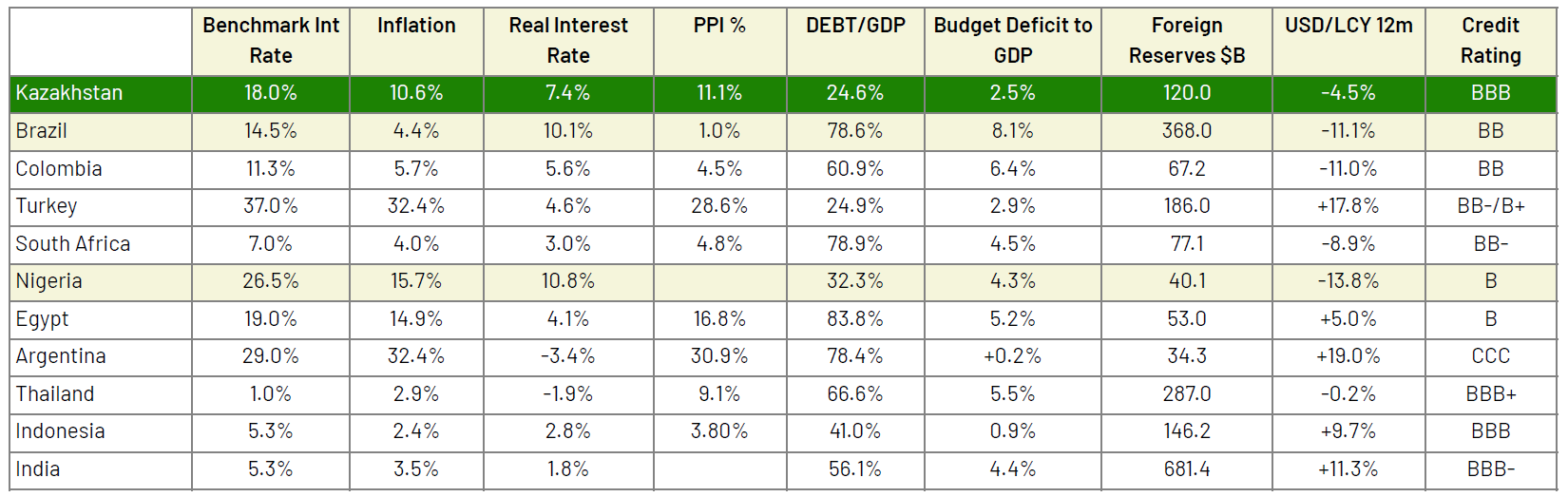
Countries, like Brazil or Nigeria offer higher real yields but with higher political volatility or debt load, budget deficit
KAZAKHSTAN: HIGHER LONG DURATION YIELDS THAN NON INVESTMENT GRADE COUNTRIES
While benchmark rate recently was lowered from 18% to 17%, tradable short (2−3 years) bonds yield currently at 16−17%, while longer-term (5−10 years) debt is traded at 15%
Compared to Brazil’s more flat curve, with longer end standing at around 14% comparing to 14.5% benchmark rate
While Nigeria’s curve inverts even more significantly with benchmark rate at 26.5% and long-term end (10+ years) is trading at 14-15%
While Nigeria’s curve inverts even more significantly with benchmark rate at 26.5% and long-term end (10+ years) is trading at 14-15%
Decline in longer term Kazakh yields partially is also driven by surging interest from foreign investors: in 2025 holdings of foreign investors in Kazakhstan government debt grew by 69% from KZT 1Trln to 1.8Trln (from approx $2Bln to $3.6bln)
Recent estimates of foreign holdings (May 2026) approaching already $ 5bln equivalent of foreign holdings in Kazakh government debt
And the total foreign holdings share in KZT government debt standing at 6.5% — for comparison, in Ukraine during 2018−2021 cycle of foreign investors' interest in local government debt the share of foreign investors' holdings reached as high as 25% (excluding debt held by National Bank of Ukraine)
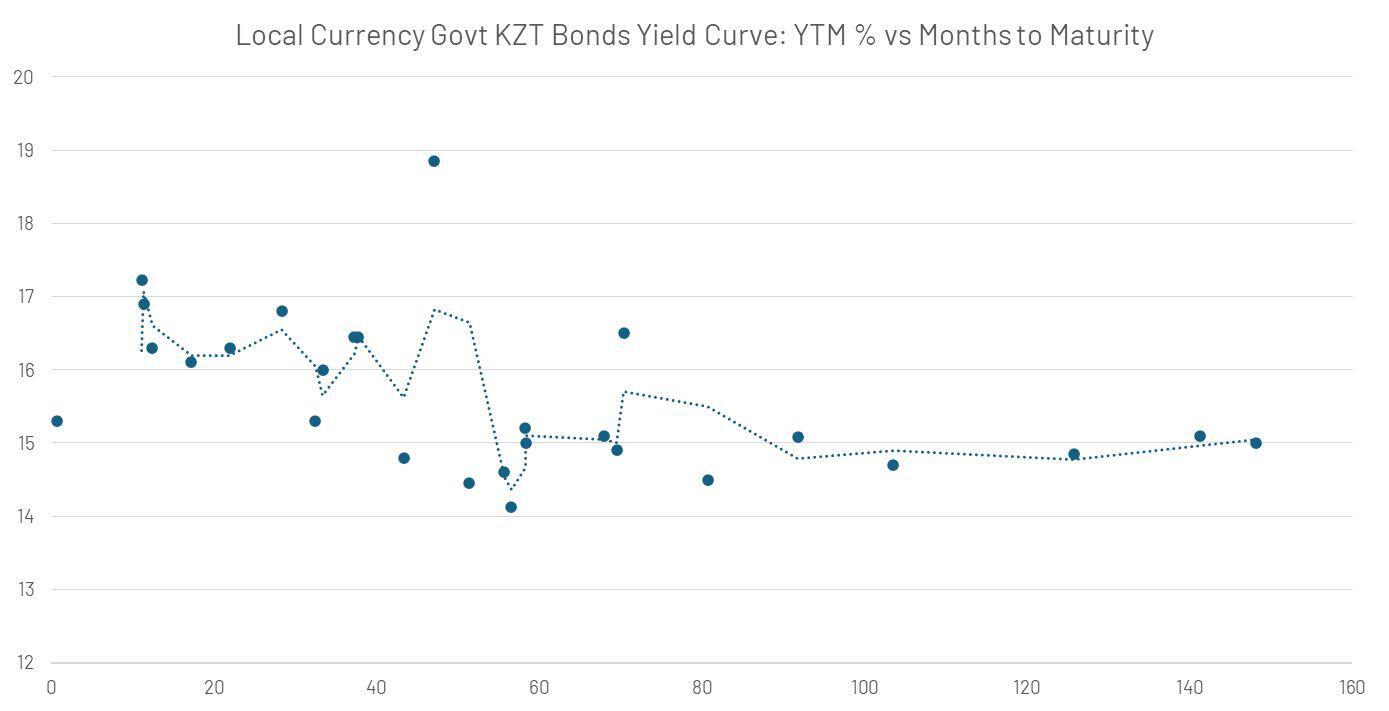
Source: Kazakhstan Stock Exchange
KAZAKHSTAN: HIGHER LONG DURATION YIELDS THAN NON INVESTMENT GRADE COUNTRIES
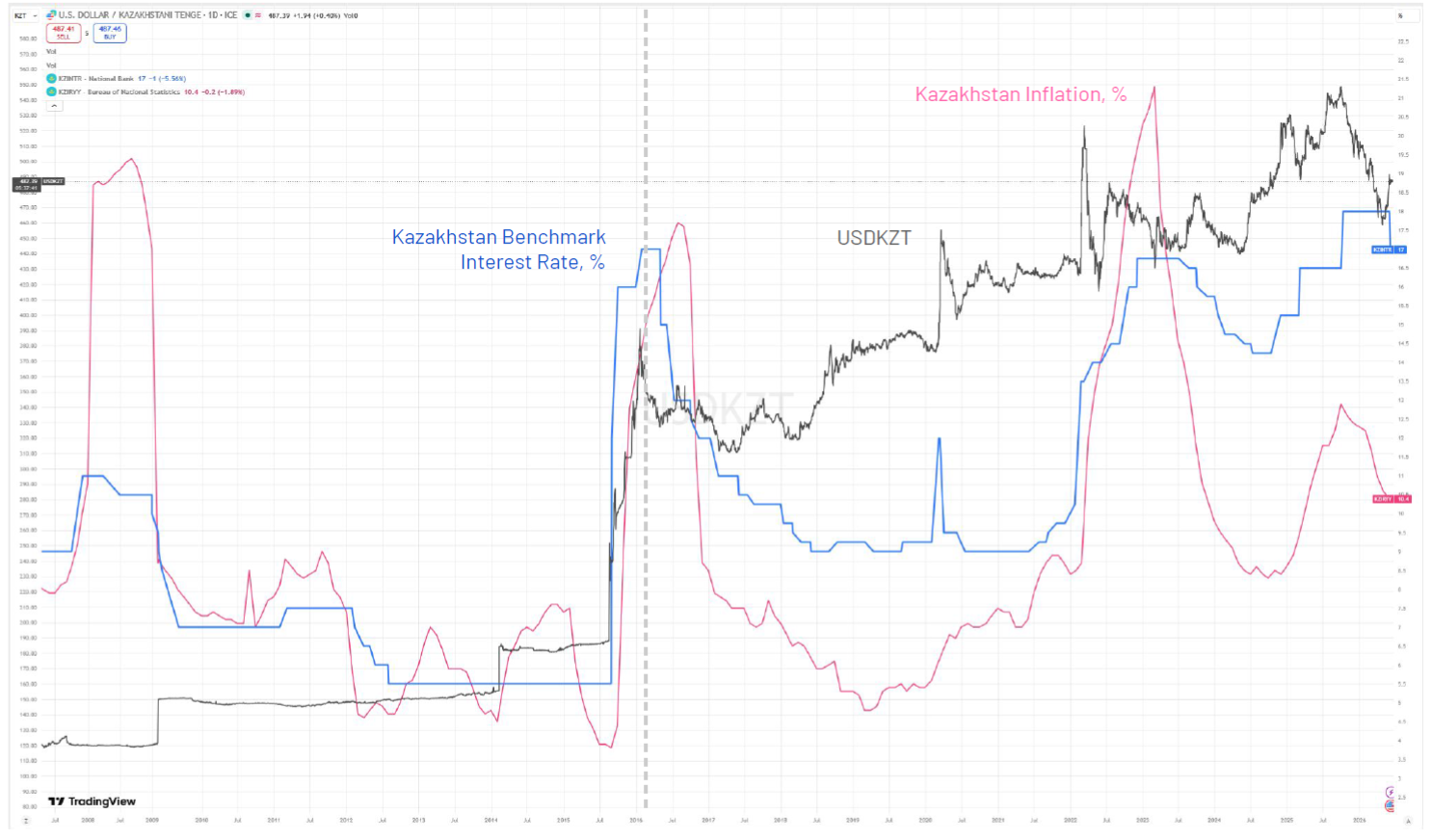
Steep KZT declines, revaluations vs USD during the past 25 years coincided with external shocks: 2009 — post-GFC, 2015 — oil and commodities crisis
During the past decade+ (2015−2025) USDKZT regime has been much less controlled as it used to be, which has also brought more long term stability
This results from a more active Central Bank’s (National Bank of Kazakhstan, NBK) response to various risks, including price stability, where NBK responded with setting much higher rates and keeping them for longer than it used to do in 2000s
This results from a more active Central Bank’s (National Bank of Kazakhstan, NBK) response to various risks, including price stability, where NBK responded with setting much higher rates and keeping them for longer than it used to do in 2000s
KAZAKHSTAN: TRANSITION FROM DOLLAR DEBT TO LOCAL CURRENCY DEBT
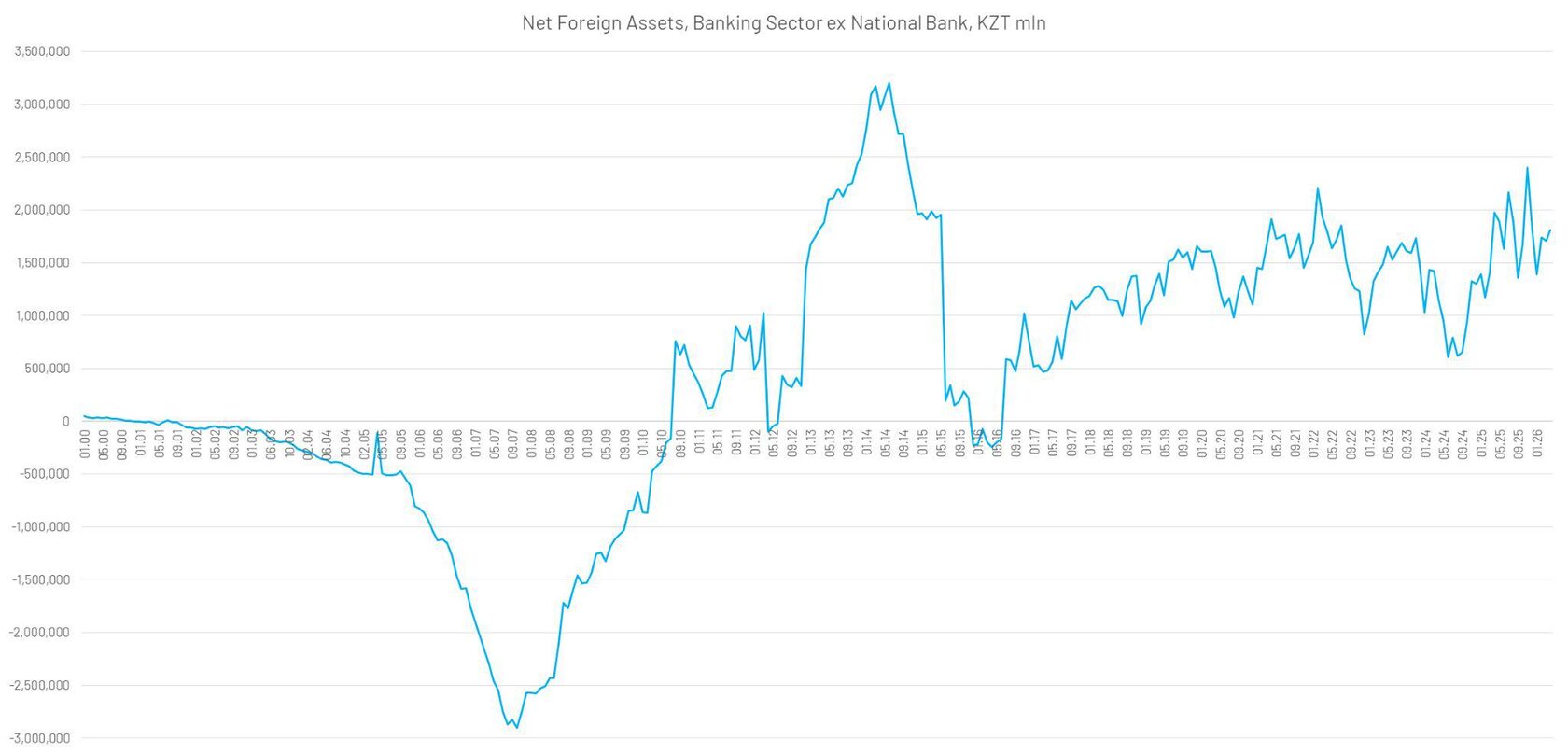
Risk of abrupt KZT corrections was partially mitigated by less reliance on FX loans - post 2008, and sudden KZT depreciation risk for borrowers was traded for higher local rates for borrowers.
While 2015-type risks are much harder to mitigate, as it needs rebalancing of the whole economic system of the country.
While 2015-type risks are much harder to mitigate, as it needs rebalancing of the whole economic system of the country.
From customers, households perspective though borrowing at 20−30%+ in KZT with no devaluation risk brings similar or even higher costs comparing to borrowing to borrowing in USD at twice lower rates, which may harm households' net disposable income, but checks for political risk in case of devaluation
Source: National Bank of Kazakhstan
KAZAKHSTAN: TRANSITION FROM DOLLAR DEBT TO LOCAL CURRENCY DEBT
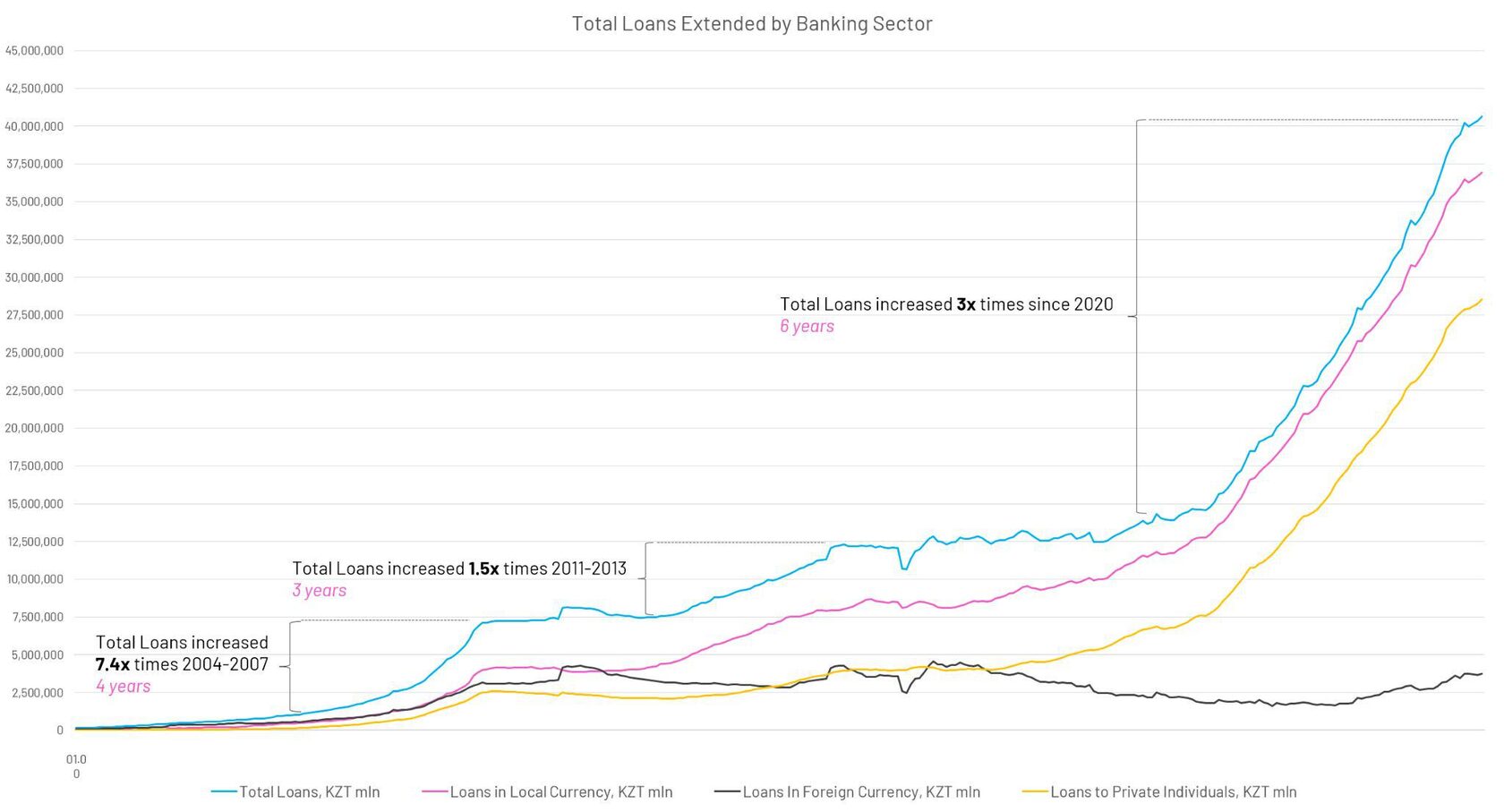
While de-dollarisation continues post 2009−2015; loans and money supply continues to grow (both from state and banking mechanisms)
Loans to private individuals grew 4.2x times since 2020 vs loans to businesses (1.7x), with private individuals' debt per capita now approaching $ 2.7k, or near $ 4.5k counting only working age population
With median salary at $ 700/month, the debt approaches 6.4 months of salary per working age capita
KAZAKHSTAN: GOVERNMENT TAKING UNPOPULAR STEPS TO STRENGTHEN BUDGET
Since COVID, we see similar problems mounting globally both across developed and emerging markets:
- Rising consumer debt;
- Slower wages growth, often much weaker than inflation;
- Rising and persistently high budget deficits;
- Slowing industrial production;
- Growing decoupling between high wealth/income strata and majority of the population
And many countries are trying to address those problems with rising taxes, lowering subsidies, tightening financial conditions.
These policies mostly leading to tighter economic and financial conditions in short to mid term, slowing down economies, consumers' net disposable income, but addressing those problems is beneficial to government bond holders both via repairing deficits and slowing demand, inflation and lowering interest rates in the future
Kazakhstan is on the active path of using all the mentioned instrumentary — however their tax rates start from a lower base and still remain low vs global average after increases
FISCAL PART: TAXES
In 2026 VAT raised from 12% to 16%. Also lowered revenue threshold for business to be registered as VAT paying ones
In 2026 introduced progressive Individual Income Tax from flat 10% to 10−15% depending on the income threshold. 15% applied to annual income over $ 73.5k equivalent
Corporate Income Tax was raised for banking and gambling business from 20% to 25%
Excise taxes on alcohol, tobacco, gasoline, luxury items grew by 10% since 2026
FISCAL PART: PRICES, SUBSIDIES
Since April 2026 Kazakhstan shifts to gradual rise in utilities prices, which may result in average price increased depending on the region by up to 20−30% in 2026
Since 2026 Kazakhstan shifts from moratorium on fuel prices increase to more market friendly pricing, which already resulted in fuel prices rise by some 15-17% in 2026
MONETARY PART: TIGHTENING RATES AND LEVERAGE
National Bank of Kazakhstan also conducts more restrictive monetary policy since the second part of 2025 by:
- Rising benchmark rate to as high as 18% (now 17%)
- Rising reserve requirements on FX liabilities to 15% by the end of 2026
- Rising reserve requirements on KZT liabilities to 5% by the end of 2026
- Tightening conditions for retail loans
- Introducing moratorium on disposal of retail NPLs to collection agencies
KAZAKHSTAN: KEY RISKS AND MITIGATION FACTORS
KAZAKHSTAN: RETURN SCENARIOS
TOTAL RETURN SCENARIO FOR 3 YEAR HOLDING PERIOD, in % (USD)
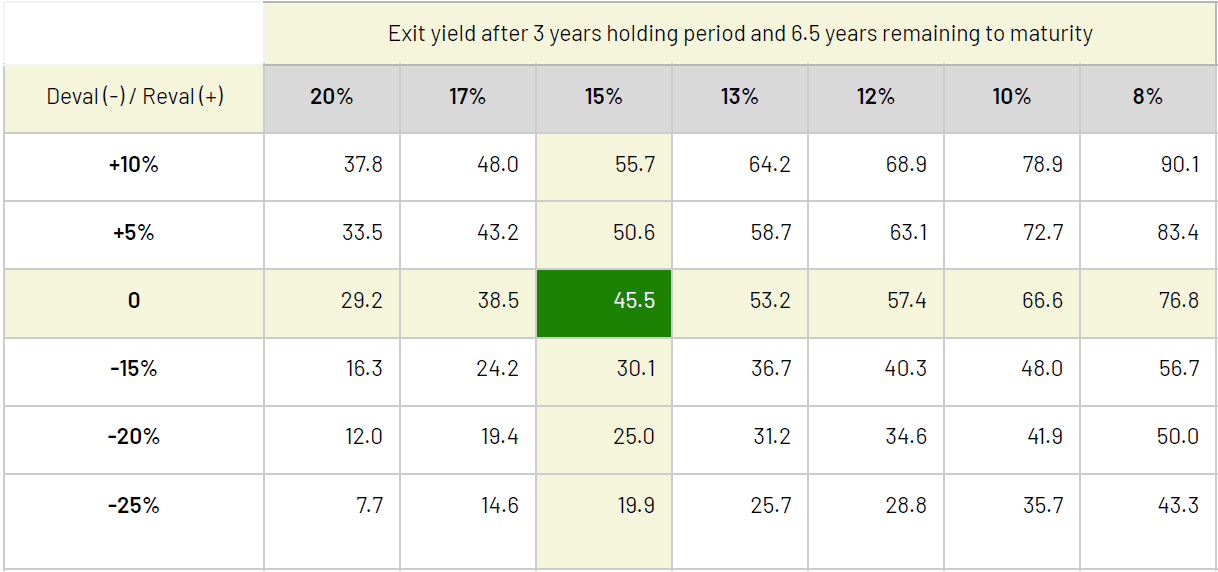
Scenarios Total Return Matrix is calculated for 9.5-years sample bond KZKD00001269 — current YTM 15.5%, current price 92.87, annual coupon 14%
Assumptions:
- Holding period - 3 years
- Exit yield as indicated
- FX change (revaluation, devaluation of KZT) happens on the exit date
- Coupons for 3Y holding period are converted in USD at current FX rate (i.e. no FX effect)
Even negative scenario of rising rate to 20% (from current 15%) and KZT devaluation of 25% in 3 years returns a slightly below (by 4pps) UST short term equivalent of 7.7% cumulative or approx 2.5% p.a. rate
Scenario with yield compression to 10% in 3 years and 15% KZT devaluation gives approx 48% of cumulative 3-years return, or 14.0% p.a. rate
KAZAKHSTAN: HOW TO DECIDE ON DURATION AND HOLDING PERIOD
LONGER DURATION vs SHORTER
Pros:
Higher probability to capture rates moderation as government’s budget improvement efforts and central bank’s tightening policy start to yield results
Higher potential of capital return / appreciation in the case of rates moderation with longer duration bonds
Index inclusion make take up to 1−2 years, which also gives longer duration bonds higher probability to benefit from that
Higher probability to capture rates moderation as government’s budget improvement efforts and central bank’s tightening policy start to yield results
Higher potential of capital return / appreciation in the case of rates moderation with longer duration bonds
Index inclusion make take up to 1−2 years, which also gives longer duration bonds higher probability to benefit from that
Cons:
Higher FX risk for longer term holdings, where even higher coupon income may not compensate for capital losses in the case of rapid KZT weakening
Higher risk in the rising rates scenario, which seems less probable with rates being at current levels
Higher FX risk for longer term holdings, where even higher coupon income may not compensate for capital losses in the case of rapid KZT weakening
Higher risk in the rising rates scenario, which seems less probable with rates being at current levels
RETURNS ILLUSTRATION - 10Y HTM BOND
Illustration for hold to maturity (HTM) investor of 15%-yield 10-year zero-coupon government KZT bond
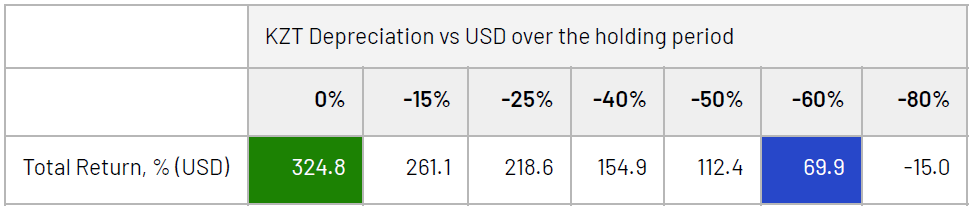
For extreme KZT depreciation cases from the past 2007−2017 — 65% KZT devaluation, or 2015−2025 — 60% KZT devaluation HTM of 10Y zero-coupon bond shows total return in USD equivalent of 70%, which is equal to 5.45% of p.a. USD return
For moderate KZT devaluation case, like the past decade (2016−2026), -35% KZT vs USD, the return equivalent in USD (hard currency) will be equal to 180% total return, which is equal to 10.8% of p.a. USD return
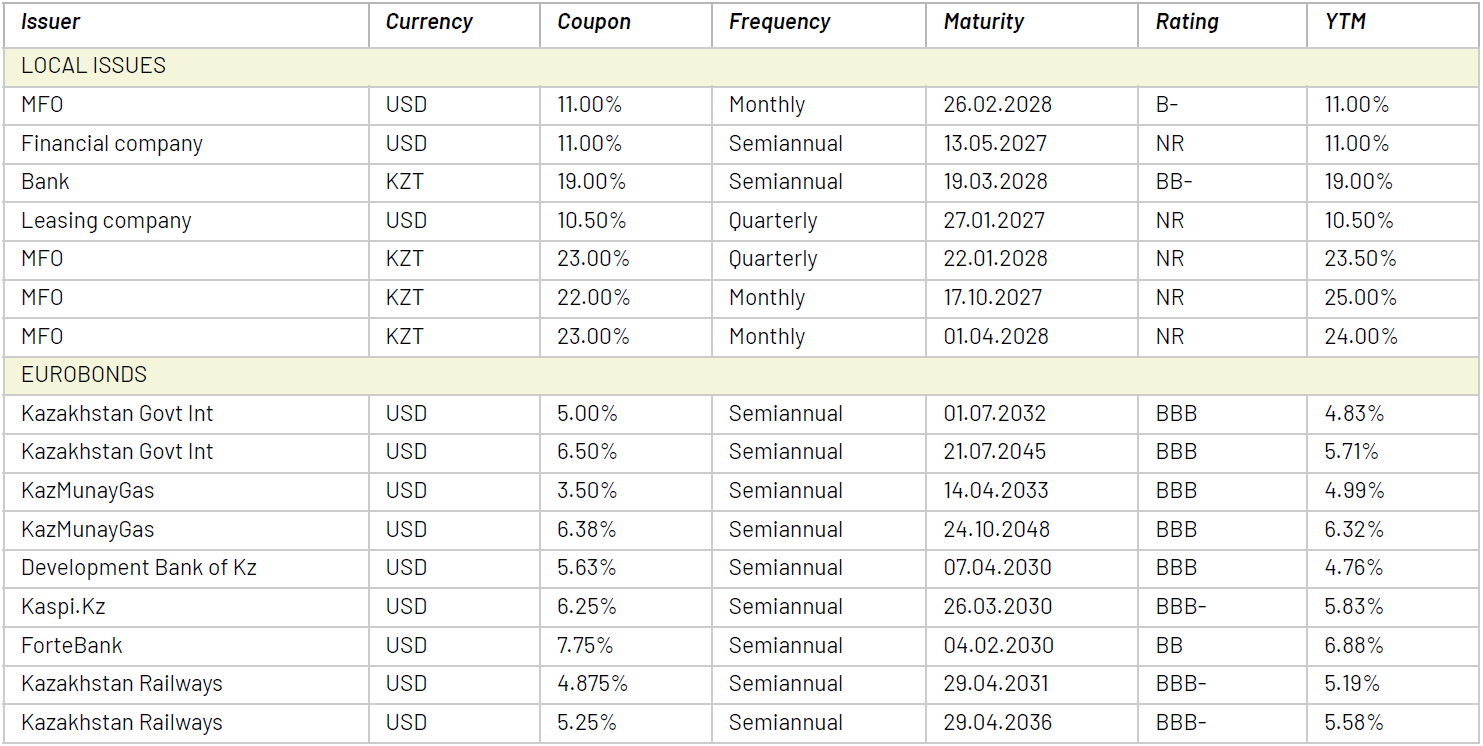
KAZAKHSTAN: ILLUSTRATIVE SAMPLE ISSUES, YIELDS FOR OTHER KAZAKHSTAN CORP AND GOVT RISK
Flag Ventures can help you remotely open a local brokerage account in countries such as Kazakhstan to access high yield fixed income.